B2B Lead Generation: The Complete Playbook (ICP, Channels, Funnel & Qualification)
A complete, actionable B2B lead generation playbook: build your ICP, pick the right channels, run sequences that earn replies, qualify with BANT, master the funnel math, and run it all without hiring a sales team.
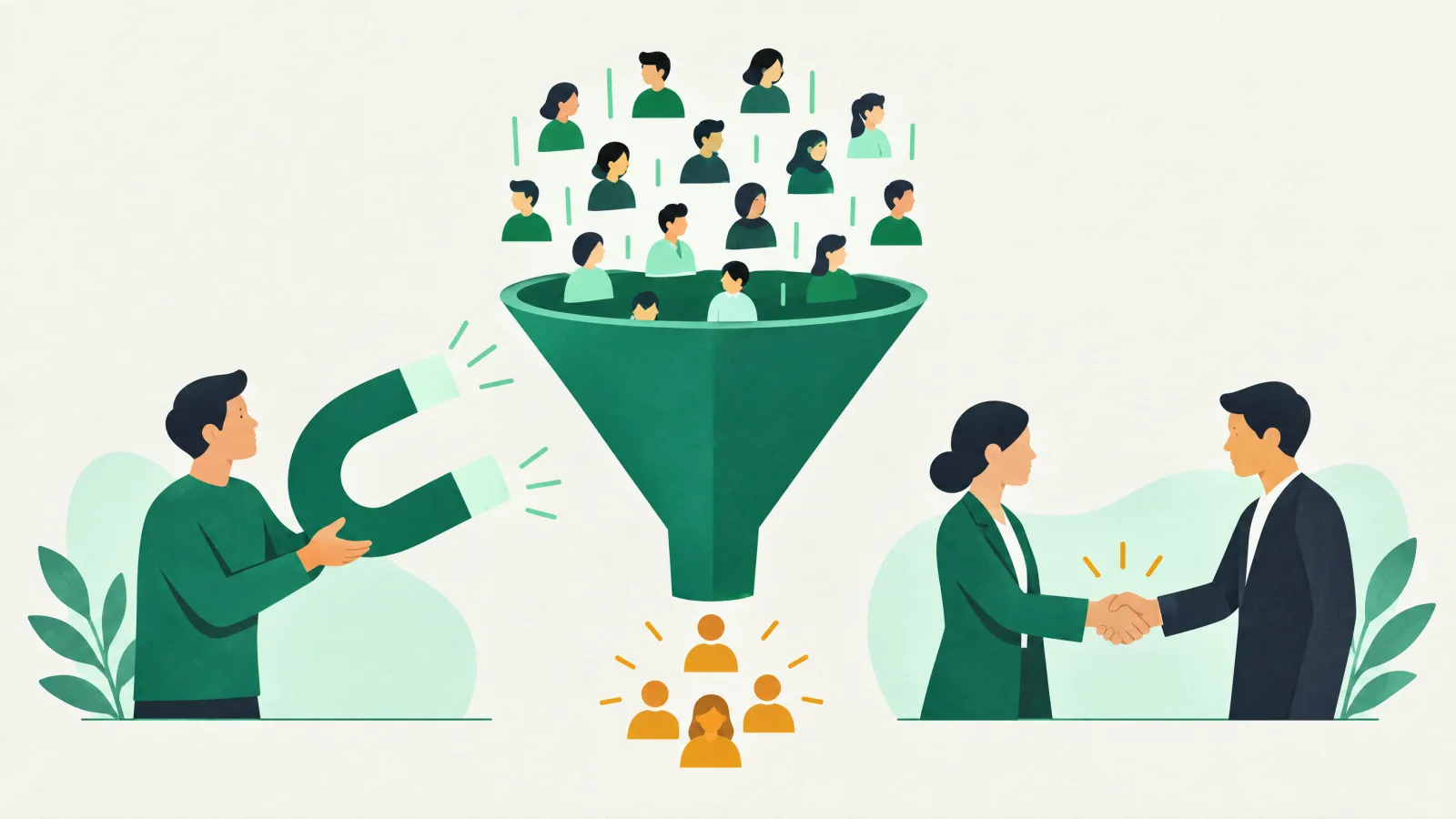
B2B lead generation is the process of attracting and converting other businesses into qualified prospects for your sales team. The core steps are the same whether you are a two-person startup or a scaling agency: define your ideal customer, pick the channels that reach them, build accurate contact data, run sequences that earn a reply, qualify hard, and measure every stage of the funnel. This guide is the full operator playbook for doing exactly that — and a realistic plan for running it even if you cannot afford a sales team yet.
Most articles on this topic stop at a list of tactics. This one goes end to end: how to build an ideal customer profile (ICP), how inbound and outbound actually differ, a channel-by-channel comparison with real ROI and cost-per-lead ranges, a reply-worthy outreach sequence, the qualification frameworks (BANT and beyond) that stop your reps wasting time, the funnel math that tells you what to fix, and how to staff the whole engine without a five-figure monthly hire.
Key takeaways
- B2B lead generation is the systematic work of turning unknown companies into qualified, sales-ready conversations — not just collecting email addresses.
- The engine has five repeatable stages: target (ICP) → reach (channels) → capture (data + offers) → nurture & qualify → measure. Skip the first stage and every later one leaks.
- Inbound (content, SEO, ads that pull buyers in) compounds and closes at far higher rates; outbound (cold email, LinkedIn, calling) is faster and predictable. Winning teams run both.
- Channels differ hugely on cost and speed — cold email and LinkedIn produce meetings in weeks, while SEO content delivers the highest long-term ROI but takes months.
- Qualify with a framework like BANT (Budget, Authority, Need, Timeline) so reps spend time only on deals that can actually close.
- You do not need a sales team to start: most of the execution — list-building, outreach, CRM hygiene, follow-up — can be delegated to a trained lead generation virtual assistant while you keep strategy and closing.
1. What Is B2B Lead Generation?
B2B (business-to-business) lead generation is the process of identifying companies that fit your ideal customer, getting in front of the right people inside them, and moving those people from "never heard of you" to "qualified and ready to talk to sales." A lead is simply a contact who has shown enough fit and interest to be worth a sales conversation. Generating leads is the work of producing a reliable, measurable flow of them.
It differs from B2C in three ways that change everything about how you do it. Deals are bigger and slower, so a single lead is worth far more. Buying decisions are made by committees — Gartner-style research consistently puts the typical B2B buying group at roughly a dozen people — so you have to reach and persuade several roles, not one shopper. And purchases are rational and justified, which means trust, proof, and education matter more than impulse.
Because of that, B2B lead generation is a system, not a campaign. The rest of this guide walks through that system stage by stage.
A lead is not a sale. The job of lead generation is to fill the top of the funnel with the right prospects so the sales process has something high-quality to work with. Volume without fit just burns your reps' time.
2. The B2B Lead Generation Engine: Five Stages
Every dependable lead-gen operation, regardless of industry, runs the same five stages in a loop. Treat them as a pipeline: a weakness in an early stage caps everything downstream.
| Stage | What you do | The question it answers |
|---|---|---|
| 1. Target | Define your ICP and buyer personas | Who, exactly, are we trying to reach? |
| 2. Reach | Choose channels — inbound and/or outbound | How do we get in front of them? |
| 3. Capture | Build lists/data and create offers that earn a contact | How do we turn attention into a known contact? |
| 4. Nurture & qualify | Sequence follow-ups and filter for fit and intent | Which contacts are worth a sales conversation? |
| 5. Measure | Track funnel conversion, CPL, and pipeline created | What is working, and what do we fix next? |
The most common failure is starting at stage two — blasting outreach before defining who should receive it. Get the targeting right and the same effort produces dramatically better results.
3. Stage 1 — Define Your Ideal Customer Profile (ICP) and Targeting
Your ICP is a description of the companies that are the best fit for what you sell; your buyer personas describe the people inside those companies you need to win over. Get specific. "Small businesses" is not an ICP. "UK-based professional-services firms with 20–200 staff that still run scheduling manually" is.
Build your ICP from three layers:
- Firmographics — industry, company size, revenue, location, tech stack. These are your hard filters for list-building.
- Triggers — events that signal a need right now: new funding, a new hire in a relevant role, expansion, a tool they just adopted. Triggers turn cold outreach into timely outreach.
- Personas — the roles in the buying committee (economic buyer, champion, end user, blocker) and what each cares about.
The fastest way to build an accurate ICP is to look backwards: list your best ten customers and find what they have in common. That pattern is your target. Everything downstream — channel choice, messaging, qualification — flows from this one document, so it is worth getting right before you spend a dollar on outreach.
4. Stage 2 — Inbound vs. Outbound Lead Generation
There are two engines for reaching your ICP, and the strongest programs run both. Inbound pulls buyers to you with content, SEO, and offers they find when they are already searching. Outbound pushes your message to a targeted list through cold email, LinkedIn, and calling. They have opposite trade-offs.
| Dimension | Inbound | Outbound |
|---|---|---|
| How it works | Buyers find you (SEO, content, ads, webinars) | You reach buyers (cold email, LinkedIn, calls) |
| Speed to first meeting | Slow — months to compound | Fast — days to weeks |
| Lead intent | High (they're already looking) | Lower (you create the need) |
| Close rate | Much higher — intent-driven leads close several times more often | Lower, but volume is controllable |
| Cost over time | High up front, cheap at scale | Steady per-lead cost |
| Predictability | Harder to forecast | Highly predictable (more activity = more leads) |
Industry benchmarks consistently show inbound leads (for example, those from SEO and content) closing at far higher rates than cold outbound leads — often by an order of magnitude — because intent does most of the work. But inbound takes months to build, and you may need pipeline now. That is why most teams aim for a blend, frequently cited around a 60/40 split favouring inbound, where content builds the brand and credibility that makes outbound convert. Start with outbound for speed, build inbound in parallel for compounding ROI.
5. Stage 2, Continued — The Channels, Compared
Within inbound and outbound sit specific channels, and they are not interchangeable. Pick two or three you can do well rather than spreading thin across all of them. The figures below are illustrative industry ranges drawn from published 2026 benchmarks — use them to compare channels relative to one another, then measure your own.
| Channel | Type | Speed | Typical cost per lead* | Best for |
|---|---|---|---|---|
| SEO / content | Inbound | Slow (3–12 mo) | Low at scale; highest long-term ROI | Compounding, high-intent demand |
| Cold email | Outbound | Fast (days) | Low (~$200–$250) | Predictable pipeline, lower ACV deals |
| LinkedIn / social selling | Both | Medium | Medium | Relationship-led, decision-makers |
| Paid search (Google Ads) | Inbound | Fast | Higher (~$450+) | High-intent searches, fast tests |
| Webinars / events | Inbound | Medium | Medium–high | Education, mid-funnel trust |
| Referrals / partners | Both | Medium | Lowest, highest close rate | Warm, high-trust pipeline |
| ABM (account-based) | Both | Slow | High (concentrated spend) | Named, high-value target accounts |
*Illustrative ranges from public 2026 benchmarks; cost per lead varies widely by industry, deal size, and execution quality. Treat them as relative, not absolute.
A practical starting stack for most SMEs: cold email + LinkedIn for speed, content/SEO for the long game, and a referral ask baked into every closed deal because referrals close at the highest rate of any channel. The day-to-day of running these — posting, prospecting, sequencing — overlaps heavily with what a marketing virtual assistant and a social media manager handle, which is why these roles are often the first to be delegated.
6. Stage 3 — List-Building, Data, and Offers
Outbound is only as good as your data. A precise list of 200 perfect-fit contacts beats a scraped list of 20,000 every time — bad data tanks deliverability, wastes effort, and trains your team to ignore the pipeline.
- Source accurately. Use data tools (such as LinkedIn Sales Navigator and reputable B2B data providers) filtered tightly to your ICP firmographics and triggers.
- Verify before you send. Run email verification to protect sender reputation; a high bounce rate can blacklist your domain.
- Enrich with context. Capture the one detail that lets you personalise — a recent post, a funding round, a relevant role change.
- Create a real reason to respond. For inbound, offer something worth an email address: a useful guide, calculator, benchmark report, or template — not a generic "subscribe."
List-building and verification are time-intensive but require little judgement once the ICP and tools are set — which makes them ideal early candidates for delegation, covered in section 10.
7. Stage 4 — Sequences That Earn a Reply
One email is not outreach; a sequence is. A good multi-touch sequence is relevant, brief, and persistent without being annoying. Here is a proven five-touch outbound structure you can adapt:
| Touch | Day | Channel | Goal |
|---|---|---|---|
| 1 | Day 1 | Personalised opener tied to a trigger; one clear ask | |
| 2 | Day 2 | Connect with a contextual note (no pitch) | |
| 3 | Day 4 | Add value: a relevant insight, case, or resource | |
| 4 | Day 7 | Short, direct nudge with a different angle | |
| 5 | Day 11 | Email / call | Polite break-up: "Should I close the loop?" |
Three rules make or break sequences: personalise the first line (the rest can be templated), make every message about the prospect not your product, and have one call-to-action per message. For inbound leads, the same discipline applies in reverse — speed of follow-up is the single biggest lever, because responding within minutes rather than hours can multiply your contact rate. Booking those conversations into the calendar is exactly the job of an appointment setter.
8. Stage 4, Continued — Qualifying Leads (BANT and Beyond)
Not every lead deserves a rep's time. Qualification is the filter that decides which contacts become Sales Qualified Leads (SQLs). The most widely used framework is BANT:
- Budget — can they afford it, and is money allocated?
- Authority — are you talking to (or close to) the decision-maker?
- Need — is there a real, urgent problem you solve?
- Timeline — when will they actually buy?
BANT is a fast top-of-funnel triage that works well for smaller, transactional deals. For large, complex enterprise sales with long cycles and many stakeholders, teams often graduate to MEDDIC (Metrics, Economic buyer, Decision criteria, Decision process, Identify pain, Champion), which probes the buying process in far more depth. Use the lightest framework that reliably predicts a close for your deal size.
Along the way, leads pass through stages worth defining so everyone speaks the same language: a Marketing Qualified Lead (MQL) matches your ICP and has shown engagement; a Sales Accepted Lead (SAL) is one sales has agreed to work; and an SQL has been validated against your qualification framework as a real opportunity.
9. Stage 5 — The Funnel Math: Metrics and Benchmarks
You cannot improve what you do not measure. B2B lead generation is ultimately arithmetic: a series of conversion rates that compound from visitor to closed deal. Knowing your numbers tells you precisely which stage to fix.
Walk the math: 10,000 monthly visitors converting at 2.5% yields ~250 leads; roughly 39% become MQLs (~98); after sales acceptance and BANT/MEDDIC qualification you reach ~31 SQLs; about 42% become opportunities (~13); and a typical close rate turns those into ~3 won deals. Double the top-of-funnel conversion alone and you roughly double closed deals — which is why obsessing over a single metric like raw lead volume can mislead. The metrics worth tracking every week:
- Conversion rate at each stage — find the leakiest step and fix it first.
- Cost per lead (CPL) and cost per opportunity — compared across channels.
- Lead-to-customer rate — the ultimate quality signal.
- Pipeline created and velocity — value and speed, not just count.
- Speed-to-lead — how fast you follow up on inbound; minutes beat hours.
10. How to Run B2B Lead Generation Without Hiring a Sales Team
Here is the practical problem for most founders and small businesses: the engine above is real work, and a full-time SDR plus a marketer is a five-figure monthly commitment before you have proven the model. You do not have to make that bet to get started.
Notice how much of the engine is execution rather than strategy: building and verifying lists, sending and managing sequences, posting on LinkedIn, keeping the CRM clean, chasing follow-ups, and booking meetings. These are exactly the high-volume, lower-judgement tasks that a trained lead generation virtual assistant can own — while you keep the parts that genuinely need you: the ICP, the messaging, and the closing conversations.
That split — delegate the doing, keep the deciding — lets a one- or two-person team run a real outbound and nurture motion at a fraction of the cost of in-house hires. For the complete breakdown of what a lead-gen VA does, how to onboard one, and what results to expect, see our dedicated guide on building a virtual lead generation assistant for your sales team. If your need is more closing than prospecting, a broader virtual sales assistant may fit better — and if you want one hire to run both the campaigns and the outreach they generate, our guide to hiring a sales and marketing virtual assistant walks through scoping, screening, and a paid test task.
Want to run this playbook without building a sales team first? Catalyst matches you with a trained, ready-to-start lead generation VA — list-building, outreach, CRM, and follow-up handled — so you keep selling. Explore our virtual assistant services, see transparent pricing, or talk to us about your pipeline.
11. Common B2B Lead Generation Mistakes
- Skipping the ICP. Outreach to a vague audience converts poorly no matter how good the copy. Define who first.
- Chasing volume over fit. A flood of unqualified leads buries your good ones and demoralises sales. Qualify harder, not louder.
- Running one channel. Single-channel programs are fragile. Pair a fast outbound channel with a compounding inbound one.
- Slow follow-up. Inbound intent decays in minutes. A lead you answer the next day is often already gone.
- No measurement. Without stage-by-stage conversion data you optimise blind. Track the funnel, find the leak, fix one thing at a time.
- Pitching too early. B2B buyers research before they talk. Lead with value and education; the pitch comes after trust.
Frequently Asked Questions
What is B2B lead generation?
B2B lead generation is the process of identifying businesses that fit your ideal customer profile, reaching the right people inside them, and converting them into qualified prospects for your sales team. It runs as a repeatable system — target, reach, capture, qualify, and measure — rather than a one-off campaign.
How do you generate B2B leads?
Define your ideal customer profile, choose two or three channels (typically cold email and LinkedIn for speed plus SEO/content for the long term), build an accurate contact list, run a personalised multi-touch sequence, qualify replies against a framework like BANT, and measure conversion at every funnel stage so you can fix the leakiest one.
What are the best B2B lead generation strategies?
The highest-performing strategies are: SEO and thought-leadership content for compounding, high-intent inbound; targeted cold email and LinkedIn outreach for fast, predictable pipeline; webinars for mid-funnel trust; and a referral ask on every deal, since referrals close at the highest rate. The best results come from combining a fast outbound channel with a compounding inbound one.
What is the difference between inbound and outbound lead generation?
Inbound pulls buyers to you through content, SEO, and ads they find when already searching — slower to build but higher intent and far higher close rates. Outbound pushes your message to a targeted list via cold email, LinkedIn, and calls — faster and more predictable but lower intent. Strong programs run both, often weighted toward inbound.
What is BANT in lead qualification?
BANT stands for Budget, Authority, Need, and Timeline — a four-point framework for deciding whether a lead is worth a sales conversation. It is a quick top-of-funnel filter ideal for smaller deals; for large, complex enterprise sales, teams often use the more detailed MEDDIC framework instead.
What is a good conversion rate for a B2B lead generation funnel?
Benchmarks vary by industry, but illustrative B2B SaaS ranges put visitor-to-lead around 1–7%, lead-to-MQL near 31–39%, SQL-to-opportunity around 42%, and opportunity-to-close between 15–40%. Track your own rates stage by stage; the value is in spotting your leakiest step, not in matching a benchmark exactly.
How much does a B2B lead cost?
Cost per lead depends heavily on channel and deal size. As an illustrative guide from 2026 benchmarks, cold email often runs around $200–$250 per lead, paid search noticeably higher, and SEO/content the lowest cost at scale though slow to ramp. Referrals are typically the cheapest and convert best. Measure CPL by channel and compare it against the value of a closed deal.
Can you outsource B2B lead generation?
Yes. Most of the execution — list-building, data verification, outreach sequences, CRM updates, follow-up, and meeting booking — can be delegated to a trained lead generation virtual assistant, while you keep strategy and closing in-house. This lets small teams run a real lead-gen engine without the cost of full-time sales hires. See our guide to lead generation VAs for how it works.
Turn the Playbook Into Pipeline
B2B lead generation rewards consistency over cleverness: a clear ICP, a couple of channels done well, disciplined sequences, hard qualification, and weekly attention to the funnel math. The teams that win are not the ones with the biggest budgets — they are the ones who run the system every week without dropping it.
The hardest part is sustaining the daily execution. Catalyst Outsourcing helps founders and small teams do exactly that, matching you with trained lead generation virtual assistants who run the prospecting, outreach, and CRM work so you can focus on closing. Explore our VA services, see how teams hire a virtual assistant in the USA, or book a conversation. For the strategic case for delegation overall, Harvard Business Review makes the argument well.
Related Virtual Assistant Services
Related Industries
Related articles
- Ideal Customer Avatar: How to Define Your ICP (Step-by-Step + Template)
- Lead Generation Specialist: What They Do & How to Hire One
- Sales Pipeline Stages: How to Build and Manage One
- Sales Development Representative (SDR): The Founder's Guide
- Sales Metrics: The 9 KPIs a Founder Should Actually Track
- Outbound Call Center Virtual Assistant: Benefits & Costs
Helpful guides
- What do virtual assistants do?
- How a managed virtual assistant works
- How much does a virtual assistant cost?
- Virtual assistant vs in-house vs freelancer
- Compare virtual assistant options
- Tasks to delegate to a virtual assistant
- Virtual assistant interview questions
- What is an employer of record?
- Virtual assistant & outsourcing glossary