Sales Development Representative (SDR): The Founder's Guide
What a sales development representative (SDR) really does, how the role differs from a BDR, AE, and lead-gen VA, what one costs, and whether to build or outsource your SDR function.
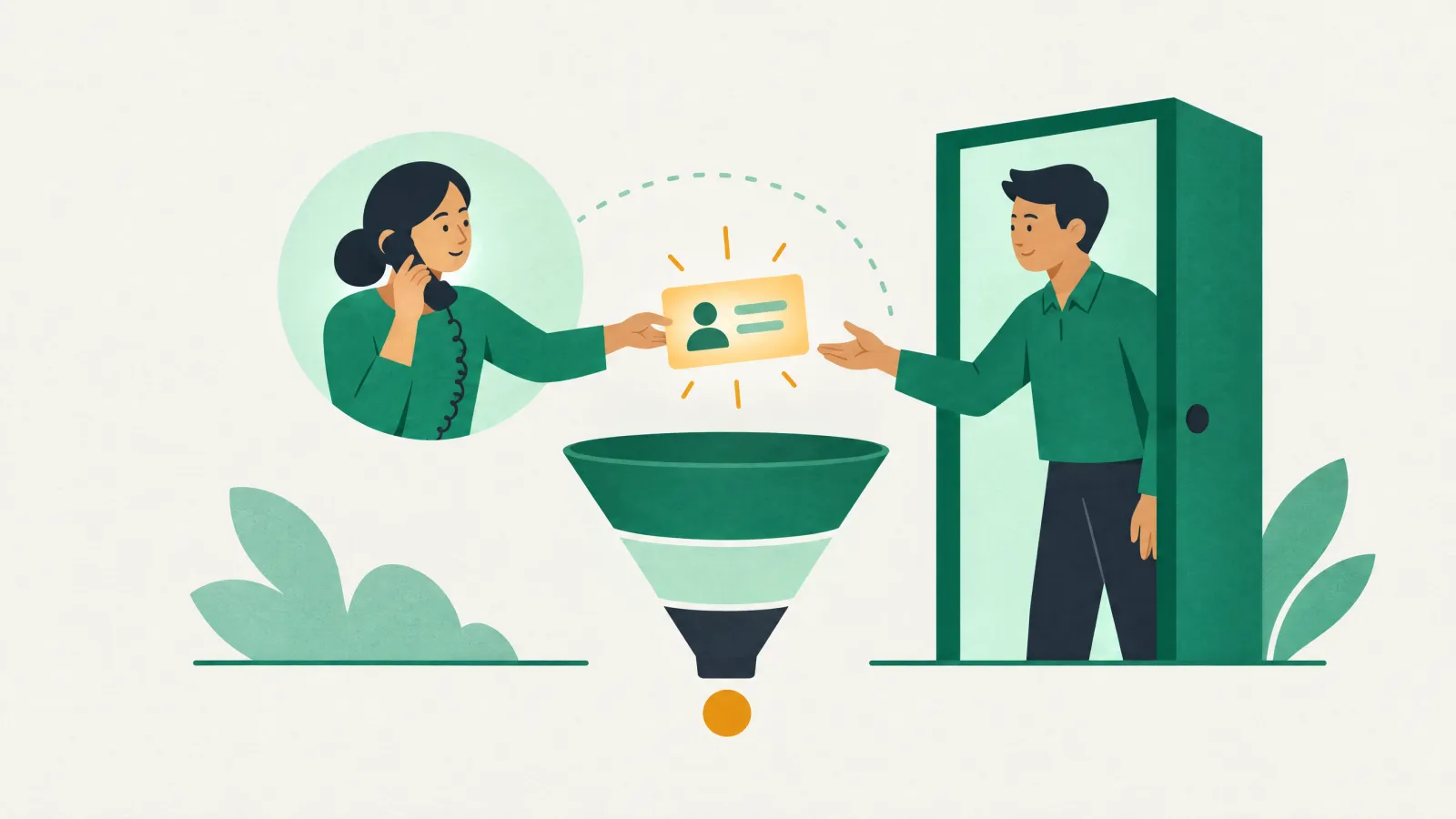
A sales development representative (SDR) is an inside-sales rep who owns the top of the funnel — outbound prospecting and qualifying inbound leads. SDRs don’t close deals; they identify and qualify potential customers, then book qualified meetings for account executives (AEs) to close. In short, SDRs generate pipeline; AEs convert it into revenue.
For a founder or sales leader, the SDR is the single role that decides whether your pipeline grows on purpose or by accident. Get it right and your closers spend their day in front of qualified buyers instead of cold-dialing strangers. Get it wrong — the wrong hire, no ramp plan, or a half-built tech stack — and you burn $90,000 a year discovering that prospecting is harder than it looks. This guide explains exactly what an SDR is and does, how the role differs from a BDR, an AE, and a lead-generation VA, the metrics and tech stack that make one productive, the real fully-loaded cost, and the central decision every growing business faces: build an SDR function in-house or outsource it.
Key takeaways
- A sales development representative (SDR) prospects, qualifies, and books meetings — the top-of-funnel engine that feeds your account executives.
- The dividing line in sales is not SDR vs BDR (the titles are used interchangeably at roughly 60% of companies) but generate-and-qualify roles vs the AE who closes.
- Judge SDRs on leading indicators (dials, emails, sequences) and evaluate them on lagging ones (qualified meetings, pipeline, conversion).
- A fully-loaded in-house SDR realistically costs $90,000–$110,000+ a year once you add tooling, recruiting, training, and management — before the ~3-month ramp to quota.
- Outsourcing or a sales-focused VA can stand up the same function in ~2–4 weeks at 40–70% less cost, which is why most lean teams start there.
- The role only pays off with the right tech stack (CRM, sales-engagement, data) and a documented playbook — talent alone isn’t enough.
1. What Is a Sales Development Representative (SDR)?
A sales development representative is a specialized inside-sales professional who handles the earliest stages of the sales process: finding potential customers, reaching out to them, qualifying their fit and intent, and booking meetings for the closers who carry a revenue quota. The defining feature of the role is the split it creates — SDRs source and qualify, account executives close. That division of labour is what turns a chaotic, founder-dependent sales effort into a repeatable machine.
The role exists because closing and prospecting are different jobs that reward different temperaments. Prospecting is high-volume, rejection-heavy, and process-driven; closing is consultative, relationship-led, and revenue-accountable. Asking one person to do both well, all day, is how most early sales hires quietly fail. The SDR specializes in the front half so your closers can specialize in the back half.
Why the role matters for founders. In a small company the founder is the SDR — until they aren’t. The moment prospecting starts competing with delivery, fundraising, or product, pipeline dries up. A dedicated SDR (in-house or outsourced) is how you make outbound a system instead of a thing you do when you remember.
What an SDR actually does day to day
- Outbound prospecting — building targeted lists of decision-makers in your ideal customer profile (ICP) and reaching them via cold calls, email sequences, and LinkedIn.
- Qualifying inbound leads — following up fast with people who downloaded content, requested a demo, or attended a webinar, and filtering for genuine fit and intent.
- Booking qualified meetings — handing AEs warm, vetted opportunities with full context, ideally within a few days of first contact.
- Research and multi-threading — mapping the buying committee, finding additional stakeholders, and personalizing outreach.
- CRM hygiene — logging every touch and keeping the pipeline clean so forecasting stays honest.
A productive ramped SDR runs in focused blocks — for example, 90-minute cold-calling sprints, separate windows for personalized video or LinkedIn voice notes, and dedicated time to research accounts and update the CRM. The discipline of time-blocking is part of what separates an SDR who books 15 meetings a month from one who books three.
The skills that make an SDR effective
Hiring managers consistently weight attitude and coachability over formal education — the role rarely requires a degree. The traits that actually predict success are research and account intelligence, active listening, assertive and concise communication, creativity (standing out in a crowded inbox), curiosity, resilience to rejection, sharp time management, and comfort living inside a CRM. Product knowledge can be taught; the temperament to make 50 calls and stay sharp on the 51st cannot.
2. SDR vs BDR vs AE vs Lead-Generation VA
These four roles get blurred constantly, and the confusion costs money — founders hire the wrong one for the job in front of them. Here is the clean breakdown.
| Role | Primary focus | Lead type | Closes deals? | Measured on | Typical level |
|---|---|---|---|---|---|
| SDR (sales development rep) | Qualifying marketing-sourced inbound leads | Warm / inbound | No | Qualified meetings booked | Entry-level |
| BDR (business development rep) | Outbound cold prospecting into net-new accounts | Cold / outbound | No | Meetings / SQLs booked | Entry-level |
| AE (account executive) | Demos, negotiation, closing | Qualified handoffs | Yes | Revenue ($) | Mid / senior |
| Lead-gen VA | List-building, research, admin, basic outreach | Top-of-funnel support | No | Activity / tasks completed | Support / assistant |
Two honest caveats. First, SDR and BDR are used interchangeably at the majority of companies; where a distinction exists, SDRs lean on inbound and BDRs on outbound, but do not over-index on the title. The meaningful line is between roles that generate and qualify (SDR/BDR) and the role that closes (AE). Second, a lead-generation VA is not a cut-price SDR — it is a different tool. A VA is excellent for list-building, data enrichment, research, and admin support, and far cheaper, but typically lacks the dedicated sales training to own full qualification. For many lean teams the smartest setup is a sales VA handling the grunt work that frees a smaller, sharper closing effort. We compare those options in depth in our guides to the virtual sales assistant and the lead-generation virtual assistant.
Where the SDR sits in the pipeline
3. The Metrics That Prove an SDR Is Working
The cardinal rule of managing SDRs: manage them on leading indicators, evaluate them on lagging ones. You coach activity (the inputs a rep controls today) and you judge outcomes (the pipeline that activity produces over weeks). Confuse the two and you either micromanage dials or wait too long to catch a problem.
| Metric | What it tells you | Illustrative benchmark* |
|---|---|---|
| Qualified meetings booked / month | The headline output of the role | ~12–15 (ramped); 18–25 for top performers |
| SDR-sourced pipeline / month | Dollar value generated for AEs | Varies widely by ACV; commonly $50K–$300K per rep |
| Dial-to-connect rate | List quality and timing | ~5–8% |
| Connect-to-meeting rate | Pitch and qualification skill | ~15–25% |
| Meeting-to-opportunity rate | Quality of qualification (no-shows, bad fit) | ~60–70% |
| Activities per booked meeting | Efficiency of the motion | ~50 = healthy; ~200 = something is broken |
| Pipeline coverage | Whether you have enough at-bats to hit quota | 3–5× quota |
*Illustrative ranges that vary substantially by average contract value, industry, and sales motion. Use your own funnel to set targets — treat these as starting reference points, not promises. The practical takeaway: if a rep is hitting activity targets but not booking meetings, the problem is messaging or targeting, not effort. If activity itself is low, it’s a coaching or capacity issue. The metrics tell you which lever to pull.
4. The SDR Tech Stack
An SDR without tools is just someone with a phone. The modern sales-development stack is what lets one rep touch hundreds of prospects a week without the work collapsing into chaos. You do not need every category on day one, but you do need the first three.
| Category | What it does | Common tools |
|---|---|---|
| CRM (essential) | System of record for every contact and deal | HubSpot, Salesforce, Close |
| Sales engagement (essential) | Builds and runs multi-touch sequences/cadences | Apollo.io, Outreach, Salesloft |
| Data & prospecting (essential) | Finds and enriches contact data for your ICP | ZoomInfo, Apollo, Cognism, LinkedIn Sales Navigator |
| Dialers | Speeds up call volume (parallel/AI dialing) | Orum, Nooks |
| Intent data | Flags accounts showing buying signals | Bombora, 6sense |
| AI SDR tools | Automates parts of research and first-touch outreach | Emerging AI prospecting agents |
Note the hidden cost here: those subscriptions add up to thousands of dollars a year per seat, which is part of why the fully-loaded cost of an in-house SDR is much higher than the salary line suggests. When you outsource, the provider typically absorbs the stack — one of the quieter advantages of the model.
5. What Does an SDR Actually Cost?
Founders anchor on base salary and then get surprised by the real number. The salary is the smallest part of the bill.
| Cost component | US (illustrative) | UK (illustrative) |
|---|---|---|
| Base salary (entry–mid) | ~$45K–$68K | ~£28K–£42K |
| On-target earnings (OTE) uplift | +60–80% of base | +£10K–£25K |
| Tools & tech stack / yr | ~$3K–$8K | ~£2.5K–£6K |
| Recruiting + onboarding (one-off) | ~$5K–$10K per hire | ~£4K–£8K per hire |
| Management & ramp loss | 3-month+ reduced output | 3-month+ reduced output |
| Fully-loaded annual cost | ~$90K–$110K+ | ~£55K–£75K+ |
Illustrative figures based on commonly cited 2026 market ranges; your numbers will vary by location, seniority, and motion. Two facts compound the cost: a new SDR takes roughly 3.1–3.2 months on average to reach full productivity (structured onboarding can compress this to 6–8 weeks), and the role carries high turnover — around 40% annually is typical. So you are not just paying $90K+ a year; you are paying it again, in part, more often than you’d like. For a fuller breakdown of staffing economics, see our guide to what a virtual assistant costs.
6. Build In-House or Outsource? The Decision Every Founder Faces
This is the question the job-board results never answer — and the one that actually matters when you’re deciding how to staff sales development. There is no universally right answer, only the right answer for your stage, margin, and deal complexity.
| Factor | In-house SDR | Outsourced SDR / sales VA |
|---|---|---|
| Time to productive | 3 months+ (recruit + ramp) | ~2–4 weeks |
| Cost | $90K–$110K+ fully loaded | ~40–70% less |
| Control over messaging | Full, direct, daily | Strong with a good provider; needs a clear brief |
| Product depth | Deep over time | Good for top-of-funnel; less for complex demos |
| Tech stack | You buy and manage it | Usually included |
| Flexibility to scale | Slow up, painful down | Scale up or down quickly |
| Management overhead | High — coaching, tools, retention | Largely handled by the provider |
| Best for | Complex, high-ACV, strategic accounts | Fast pipeline, testing outbound, lean teams |
A blunt reality check: one widely cited survey found 67% of companies said their outsourced SDR initiative didn’t work and only 7% called it highly successful. That isn’t an argument against outsourcing — it’s proof that provider selection and a clear brief are everything. The teams that succeed treat an outsourced SDR like an in-house one: a documented ICP, a real playbook, weekly feedback, and shared metrics.
For most early and growth-stage businesses, the sensible sequence is: start outsourced or with a trained sales VA to prove the motion fast and cheap, then bring it in-house once the playbook is repeatable and the deal value justifies the overhead. A growing number of teams run a hybrid — in-house reps on complex, high-value accounts and outsourced capacity for top-of-funnel volume and fast scaling.
Not sure whether to hire or outsource your first SDR? Catalyst Outsourcing places trained, sales-ready remote SDRs and sales assistants in about two weeks — with the tech stack and playbook handled. Explore our virtual assistant and sales support services or book a free consultation to map your options.
7. How to Hire and Onboard an SDR That Performs
Whether you build in-house or outsource, the difference between an SDR who generates pipeline and one who quietly costs you $90K comes down to a handful of decisions made before and during the first 60 days. Here is the sequence that works.
- Define the ICP and the offer first. No SDR can prospect their way out of a vague target market. Write down exactly who you sell to (industry, size, role, trigger) and the one-line reason they should take a meeting. This brief is the single biggest predictor of outbound success — and the thing outsourced engagements most often skip.
- Hire for temperament, not résumé. Screen for coachability, resilience, and clear communication over years of experience or a degree. A curious, organized rep who takes feedback will out-perform a polished one who can’t handle rejection. Use a short role-play in the interview — have the candidate cold-call you.
- Set up the stack before day one. CRM access, a sales-engagement tool, and a data source should be live and loaded with a starter list before the rep arrives. An SDR idling for a week waiting on logins is wasted ramp.
- Give them a playbook, not just a phone. Documented call scripts, email sequences, objection responses, and qualification criteria turn week-one guesswork into week-one activity. This is where a good outsourcing partner earns its fee — the playbook is built in.
- Ramp on leading indicators. For the first 4–6 weeks, measure activity and quality of conversations, not meetings booked. Listen to calls, review emails, and coach daily. Meetings will follow once the inputs are dialed in.
- Review weekly against the metrics in section 3. By week eight you should see the funnel taking shape. If activity is high but meetings are low, fix targeting or messaging; if activity is low, address coaching or capacity. Don’t wait a full quarter to act on a broken funnel.
The same discipline applies whether the SDR sits in your office or works remotely through a partner. For the broader mechanics of vetting and onboarding remote talent, our guide to hiring a virtual assistant covers the process step by step, and the appointment setter guide details the close-cousin role focused purely on booking meetings.
8. How an SDR Drives Business Success
Strip away the jargon and an effective SDR delivers four compounding outcomes:
- A predictable pipeline. Outbound stops being a thing that happens when someone remembers and becomes a steady, measurable input you can forecast against.
- Closers who close. Your most expensive sales talent spends their hours in front of qualified buyers instead of building lists and chasing no-shows — the single biggest productivity unlock in most sales orgs.
- A shorter sales cycle. Fast, well-qualified handoffs mean fewer dead-end demos and quicker movement from first touch to decision.
- Market intelligence. SDRs live on the front line of objections, pain points, and competitor mentions — feedback that sharpens your messaging and positioning.
Those outcomes are why a dedicated sales-development function repays its cost many times over once it’s running well — a single qualified meeting that turns into a recurring customer can cover months of SDR investment. Whether you hire locally or remotely, our teams serve clients across the USA and UK, matching trained sales talent to your ICP and playbook.
Frequently Asked Questions
What does a sales development representative (SDR) do?
An SDR prospects for new customers, qualifies inbound and outbound leads against your ideal customer profile, and books qualified meetings for account executives to close. They own the top of the funnel — generating pipeline rather than closing revenue.
What is the difference between an SDR and a BDR?
The titles are used interchangeably at most companies. Where a distinction exists, SDRs typically qualify inbound, marketing-sourced leads while BDRs focus on outbound cold prospecting into net-new accounts. Both generate and qualify pipeline; neither closes deals.
What is the difference between an SDR and an account executive (AE)?
SDRs generate and qualify pipeline, then hand off; AEs run demos, negotiate, and close deals while carrying a revenue quota. The SDR is usually an entry-level role and a common stepping stone into an AE position.
How much does an SDR cost to hire?
US base salaries run roughly $45K–$68K (UK £28K–£42K), but the fully-loaded cost — adding OTE, tools, recruiting, training, and management — is closer to $90K–$110K a year. Outsourcing the role typically costs 40–70% less. (Illustrative 2026 ranges.)
How long does it take a new SDR to ramp up?
The industry average is about 3.1–3.2 months to full productivity. Structured, signal-driven onboarding can compress that to roughly 6–8 weeks, while rushed onboarding often stretches the dip to several months.
What metrics should I use to measure an SDR?
Coach on leading indicators (dials, emails, sequences sent) and evaluate on lagging ones: qualified meetings booked, pipeline sourced, and conversion rates through the funnel. A useful health check is activities per booked meeting — around 50 is healthy, around 200 signals a targeting or messaging problem.
Should I outsource my SDR function or build it in-house?
Outsourcing or a sales-focused VA stands up the function in about two to four weeks at far lower cost and is ideal for lean teams, fast pipeline, and testing outbound. In-house makes more sense for complex, high-value, strategic accounts. Many teams start outsourced and bring it in-house once the playbook is proven — or run a hybrid.
Is an SDR the same as a lead-generation virtual assistant?
No. A lead-generation VA is excellent for list-building, research, enrichment, and admin support, and is cheaper, but typically lacks the dedicated sales training to fully qualify prospects. A trained sales VA or outsourced SDR is the better fit when you need real qualification and booked meetings, not just lists.
Turn Sales Development Into a System
A sales development representative is the difference between a pipeline you can forecast and one you hope shows up. The role itself is straightforward — prospect, qualify, book — but doing it well takes the right person, the right metrics, the right stack, and a documented playbook. The hard part for most founders isn’t understanding the role; it’s deciding how to staff it without sinking $100K and three months into a bet that might not pay off.
That’s where Catalyst Outsourcing helps. We place trained, sales-ready remote SDRs and sales assistants — with tooling and onboarding handled — so you can build pipeline in weeks, not quarters, and scale up or down as you learn. Explore our sales support services, see transparent pricing, or book a free consultation to decide whether to build or outsource your SDR function. As Harvard Business Review notes, the businesses that win are the ones that turn selling into a repeatable, learnable system — and the SDR is where that system begins.
Related Virtual Assistant Services
Related Industries
Related articles
- Sales Metrics: The 9 KPIs a Founder Should Actually Track
- Outbound Call Center Virtual Assistant: Benefits & Costs
- Lead Generation Specialist: What They Do & How to Hire One
- How to Hire a Sales and Marketing Virtual Assistant (Full Guide)
- B2B Lead Generation: The Complete Playbook (ICP, Channels, Funnel & Qualification)
- How to Scale a Sales Team: Capacity Over Headcount
Helpful guides
- What do virtual assistants do?
- How a managed virtual assistant works
- How much does a virtual assistant cost?
- Virtual assistant vs in-house vs freelancer
- Compare virtual assistant options
- Tasks to delegate to a virtual assistant
- Virtual assistant interview questions
- What is an employer of record?
- Virtual assistant & outsourcing glossary